
What a ceasefire in the Gulf doesn’t end.
Published in the Australian Financial Review, 11 August 2026
This Gulf war began over a nuclear programme. It is nowbeing fought over a waterway.
That shift is the most consequential development of the past five months. Earlier this month the US pointed to an announcement for 5 August; that day passed, and the four after it. The question is no longer whether the Strait reopens, but who administers it and at what price. Tehran has now published its price.
There are two documents, and they are not versions of each other. The first is the interim mechanism: sixty days, inbound through Iranian waters, outbound through Omani, no tolls during the temporary period. The second appeared on 6 August, when the Revolutionary Guard’s Fars news agency published a bill now before their parliament’s national security committee: American and Israeli vessels barred permanently, entry managed by Iran, exit jointly with Oman, a fee on every vessel reported at up to seven per cent of cargo value. Oil rose on publication. Washington rejected it the same day.
The second completes the first rather than displacing it: the interim arrangement suspends the toll, the bill legislates what is charged when the suspension ends.
This is an Iranian-administered transit regime, not a restored right of transit. A right of transit is exercised; an administered regime is granted, by a party that can withdraw it. Nor is the toll waiver a baseline: Iran legislated a transit fee in March and has been collecting since. The waiver holds only ‘during the temporary period’, and sixty days is the interval the June memorandum used before it was declared void.
This would be the seventh de-escalation announcement in five months. Every previous one was undone within days, and ships are still being hit. Something may well be different this time, though I would hold that view loosely.
Tehran has discovered that its most usable power is not its nuclear programme but its geography. Enrichment invites strikes. A chokepoint is usable in increments, deniable, and with tolls attached it pays. Washington cannot extinguish that claim without a campaign of the scale called off on 1 August, and Tehran cannot have it conceded by an administration facing midterms.
Nor does an Oman deal settle much. Tehran’s foreign minister says one is very close, but says reopening also requires lifting the American blockade, unfreezing assets, ending the war and paying compensation. A framework may be signed this week and the Strait stay shut.
What that produces is not peace and not war. It is durable ambiguity: traffic restored, governance unresolved, re-escalation whenever it is tested.
Any deal to reopen the Strait, no matter how short-lived, will be welcomed regardless. Daily transit has fallen from a pre-war 15 to 20 million barrels a day to an estimated two to five million, and petrol in the US sat at US$4.01 a gallon on 9 August. Here is what an agreement leaves.
First, control of a chokepoint will have been converted into a recognised entitlement, administered in coordination and on a renewable basis. The clearest tell is not the fee. Tehran describes the agreed route as temporary, running until Iran and Oman replace the Traffic Separation Scheme, an International Maritime Organisation instrument. Two states replacing it between themselves is the entitlement, whatever the fee turns out to be. This is a dangerous precedent that will be observed closely elsewhere.
The second is that while a ceasefire will lower the oil price, it will do much less to lower the cost of money.
With US midterms approaching and the Senate now contestable, there is a political clock on the energy component of long yields. There is none at all on the rest.
If long-term rates were mainly an energy story, this war should show it. Early on it did. Then it stopped. On 23 March a five-day pause knocked more than ten per cent off Brent, and the ten-year hit 4.48 per cent within four sessions. Through the June ceasefire, headline inflation fell to 3.5 per cent and the ten-year still sat at 4.49 on 2 July. On 31 July, with oil near US$88, it closed at 4.74, which was its high for the cycle.
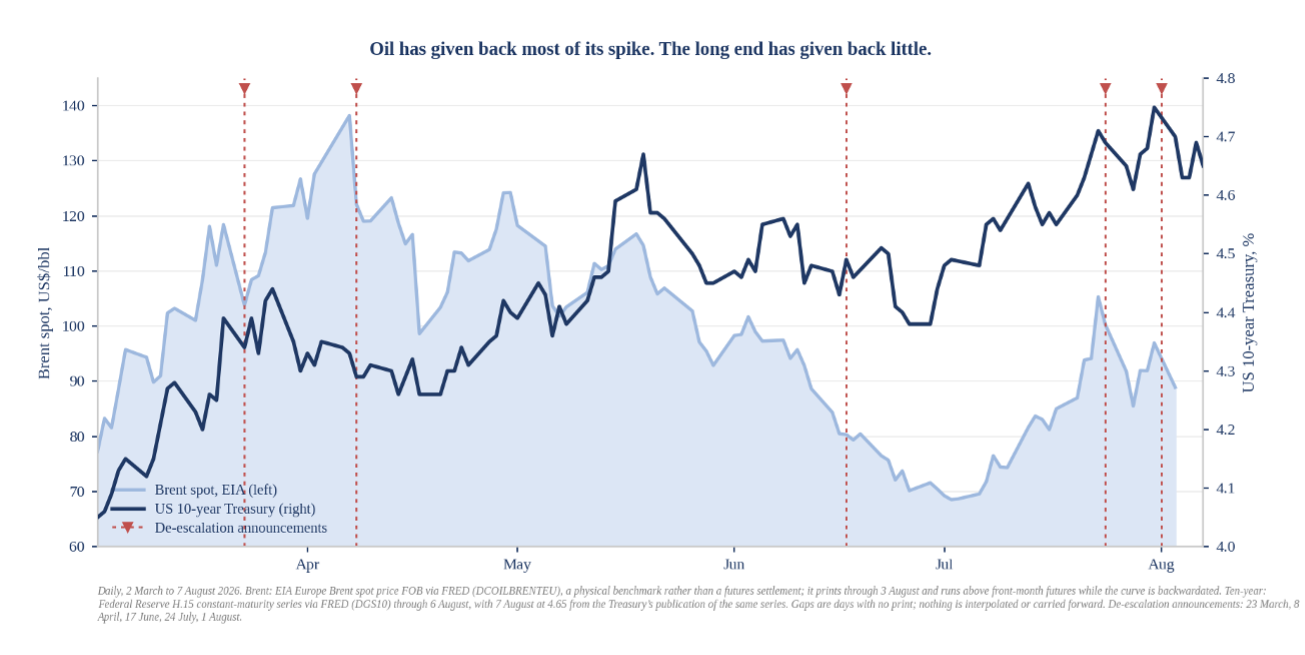
The clearest test came in the first week of August, and it had nothing to do with oil. On 7 August the July payrolls report showed the economy had shed 23,000 jobs against a consensus gain of 86,000, with May and June revised down a further 103,000. Yields fell, but barely, and the front end was pricing fewer rate rises, not cuts. The thirty-year closed the week at 5.192 per cent, two basis points below its highest level since 2007. The mortgage rate rose regardless.
While oil has given back most of its spike, the long end has given back nothing. This is not the war’s inflation arriving late: the market’s own ten-year inflation forecast fell from about 2.40 per cent in April to 2.28 in late July. Almost the entire rise in yields is the return demanded after inflation.
This is not only an American story. In late January the thirty-year Japanese government bond jumped thirty basis points to above 3.8 per cent and the forty-year through 4, records for both, and the American thirty-year rose with it. Japanese investors sold US$29.6 billion of American debt in the first quarter alone.
Which brings me back to 31 July, the day the United States and Japan bought yen together, the first such joint operation since 1998. Washington funded its side by selling euros rather than Treasuries, and Tokyo flagged drawing dollars through a Federal Reserve facility that lends against Treasury holdings rather than requiring their sale. Both were engineered to keep Japanese Treasury selling out of the market and for Washington to protect the depth of the bid for its own long-dated paper.
A settlement in the Gulf will remove an acute energy premium, but will leave everything else, because the claims on long-dated capital are indifferent to Hormuz. There are five, and none of them is cyclical: a thinning buyer base for long-dated paper; the artificial-intelligence build’s migration from the equity side of the balance sheet to the credit side; the demographic arithmetic of the care economy; a politics that has left governments less able to consolidate; and the simultaneous rearmament of the democratic world. These are all topics worthy of greater analysis. Each is already legislated, contracted or demographically determined.
In the Gulf, the headlines will report a ceasefire. What will have been agreed, if anything, is a price for passage, and Tehran has now written that price down. Only one of those ends the war. Neither lowers the price of the capital that pays for everything else.